Lake Michigan Water in Illinois: Which Communities It Reaches
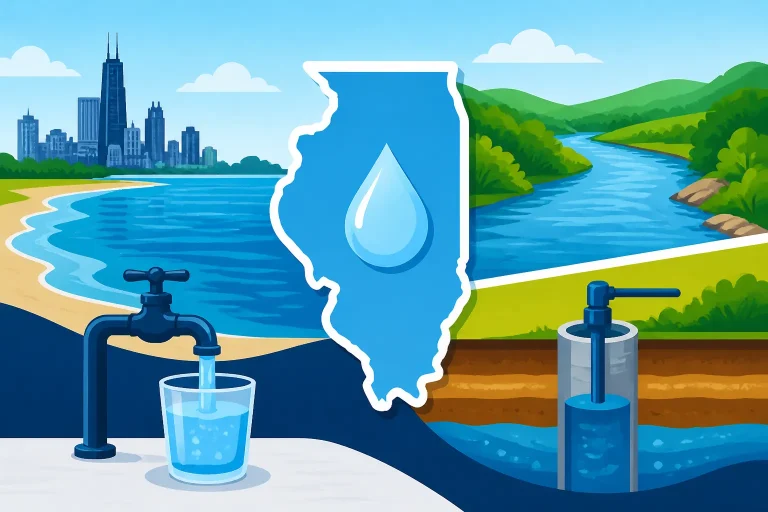
Lake Michigan is a major source of drinking water for Illinois, but living near the lake does not mean your home receives lake water. Supply arrangements can differ between neighboring communities, and a town’s source may not tell you what reaches a particular address. Here’s how to identify the confirmed example, check your own supplier, and read the records that describe your tap water.
What it means for a community to get Lake Michigan water
When someone says a town “gets Lake Michigan water,” they usually mean the community’s drinking-water supply comes from the lake, either directly or through a supplier that treats and delivers it. That description can leave out important details: which organization sells the water, who manages the pipes inside town, and whether every address in the area is served the same way.
A community may operate its own treatment and distribution system, or it may purchase treated water from another provider. A regional or municipal supplier can also serve customers beyond the boundaries suggested by its name. That means a town’s source and a household’s supplier are related questions, but they are not always interchangeable.
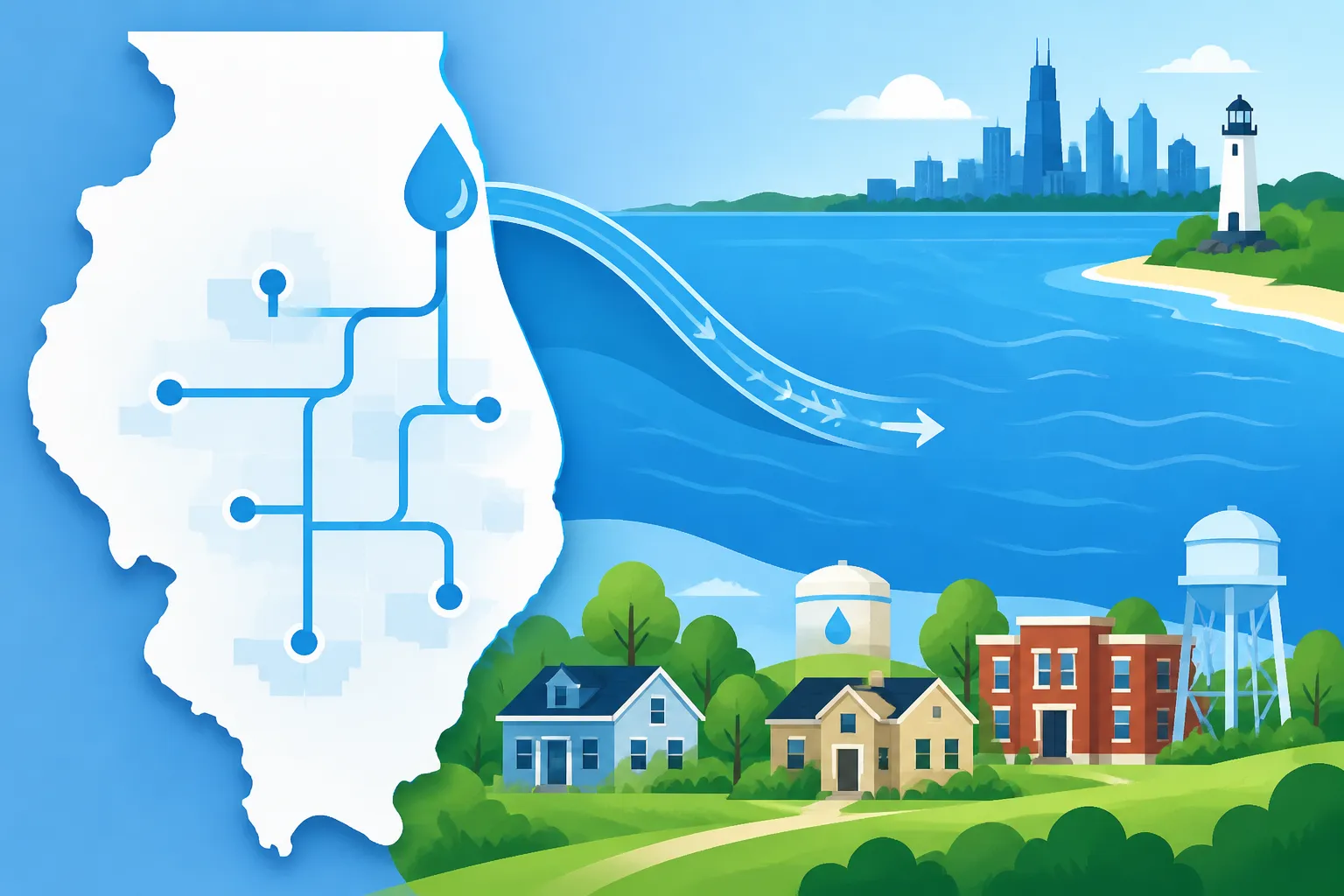
The relevant chain is often:
- A source provides raw water, such as lake water, river water or groundwater.
- A water supplier treats it and makes it available for delivery.
- A local utility or municipal department may distribute it through neighborhood pipes.
- A customer’s address connects to a particular service area and account.
The exact arrangement depends on the area. For that reason, a neighbor’s answer, a town name, or a map shaded as “lake supplied” may be a useful clue but is not always enough to identify the source for a specific property.
It also helps to separate the source of the water from its condition. Knowing that water comes from a lake does not, by itself, tell you what was detected in the finished water or what enters it from plumbing inside a building. Those questions are addressed through treatment information, water-quality reports and, where appropriate, testing at the tap. For the broader picture of Illinois sources, see Where Illinois Tap Water Comes From: Lake, Rivers and Wells.
The confirmed community example: Naperville
Naperville is a confirmed example of an Illinois community whose drinking-water supply comes from Lake Michigan. The City of Naperville identifies Lake Michigan as the source of its drinking water. Its annual Water Quality Report states that the supply complies with all water quality standards as listed in the Safe Drinking Water Act.
That information establishes the source and the report’s statement about compliance. It does not establish that every nearby community uses the same source, that every property near Naperville’s boundaries is served by the same system, or that a report for a community supply describes the water at every individual faucet. Those details need to be checked for the address and the question at hand.
When using Naperville as a reference point, keep these distinctions in mind:
- Source: The City of Naperville identifies Lake Michigan as the drinking-water source.
- Reported compliance: The city’s annual Water Quality Report says its supply complies with all water quality standards as listed in the Safe Drinking Water Act.
- Local delivery: The city’s report describes the community’s supply, while a property’s plumbing can affect water after it leaves the public system.
- Other communities: Naperville’s source does not prove what supplies another town, subdivision, building or neighboring address.
A city report is a good place to understand the system it covers, but it should not be treated as a regional directory. If you are comparing communities or checking a home before a move, look up the supplier and report associated with the property rather than relying on a nearby city’s information.
For context on what a report can and cannot tell you, read Consumer Confidence Reports in Illinois: Reading Your Water Report. If you are trying to locate the report for a particular community, Tracking Down a City’s Annual Water Quality Report Each Spring explains what to look for.
How to check whether your address gets Lake Michigan water
The most reliable starting point is to identify the water supplier for the exact address. A city boundary map or a community’s general description may not show every service-area exception. Addresses in unincorporated areas, subdivisions, border streets or buildings with shared arrangements can be especially easy to misidentify.
Use this process to verify the source:
- Find the supplier named on the water bill. Look for the organization responsible for the water account, not only the name of the municipality. If water and sewer charges appear together, check which entity supplies the water and which entity handles billing or sewer service.
- If you do not have a bill, ask who serves the address. A landlord, seller, property manager or local utility may be able to identify the supplier. Ask for the supplier’s full name and the system or service area that covers the property.
- Check the supplier’s official water-quality report. Look for the section describing the source of drinking water. Confirm that the report applies to the supplier or system serving the address, rather than to a neighboring community.
- Ask whether the local utility buys water from another supplier. A local department may distribute water without being the organization that treats or wholesales it. Ask where the purchased water originates and whether the answer applies to your address.
- Confirm unusual service arrangements directly. If the property sits near a boundary, is part of a subdivision, or has a private or shared system, ask the supplier to confirm the service arrangement for the specific address.
- Keep the report and supplier details together. Save the report year, system name and contact details from the official website so you can find the right information again.
The bill is a practical first clue, but it may not settle the source question. Some bills combine water charges with sewer or other municipal charges, while the water provider may be a different organization. If the account holder is a landlord or another person, you may need to ask the property owner or supplier which system serves the building.
If you are unsure where to begin, How to Find Out Who Supplies Water to Your Illinois Address is a useful next step. If the supplier is a town or regional company that sells water to local utilities, How a Regional Water Wholesaler Supplies Suburban Utilities explains why the name on a bill may not tell the whole story.
| What you know | What it can tell you | What to check next |
|---|---|---|
| Your town is near Lake Michigan | The area may be within reach of lake-supplied systems | Identify the supplier for your exact address |
| A neighbor says the town uses lake water | The neighbor may know their own service arrangement | Check whether your property uses the same supplier and system |
| Your bill names a local utility | It identifies an account or billing contact | Ask whether that utility treats water or buys it from another supplier |
| A report names Lake Michigan | The report identifies a source for the system it covers | Confirm that the system serves your address |
| A property is outside town limits | The municipal service arrangement may not apply | Ask the supplier or property owner to confirm the source |
| A report says the supply meets applicable standards | It describes the system’s reported water-quality status | Consider whether you have a separate question about building plumbing or a home test |
The most useful answer is specific: “This supplier serves this address, and this report describes that system.” A broad statement such as “the suburb gets lake water” can be correct for much of a community while still leaving a property-specific question unresolved.
Why a town name may not be enough
Municipal boundaries, water-system boundaries and billing boundaries do not always line up neatly. A home can have a mailing address associated with one place while receiving water from a supplier serving a wider area. A town may also purchase water from a larger supplier rather than drawing and treating water itself.
That is why it helps to ask separately:
- Which organization supplies water to this address?
- What source does that supplier use?
- Does the report I found cover the system serving this property?
- Is the local organization the water provider, the distributor, the biller, or some combination?
- Does the building have a shared meter or another arrangement that affects who receives the account information?
These distinctions matter when comparing service areas. A map that shows a general supply region can help orient you, but the supplier’s own report and address confirmation are stronger evidence for a particular property. If a report covers a larger system, ask the utility whether the property is included.
A source can also be described at more than one point in the delivery chain. The raw source may be Lake Michigan, while the organization sending the bill may be a local utility that distributes purchased water. That is not necessarily a contradiction. It can reflect different roles in the supply system.
The reverse can happen, too: a community may use a source other than the lake even if it is geographically close to a lake-supplied area. Nearby geography alone cannot confirm a connection. Nor does the name of a company or town necessarily reveal whether the water is drawn from a lake, river or well. For a direct comparison of those source types, see From Intake Crib to Kitchen Faucet: How City Water Travels in Illinois.
When information conflicts, do not choose the answer that sounds most plausible. Compare the supplier name, service area and report period, then ask the official supplier to confirm which system applies. A concise question is often enough: “Does this address receive water from a system whose source is Lake Michigan, and which water-quality report covers it?”
How to use a water-quality report to confirm the source
A water-quality report is useful only when it belongs to the system serving your home. Start by checking the report’s title and the supplier or system name. Then find the section that identifies the source of the drinking water. The language may describe a source directly or explain that water is purchased from another provider.
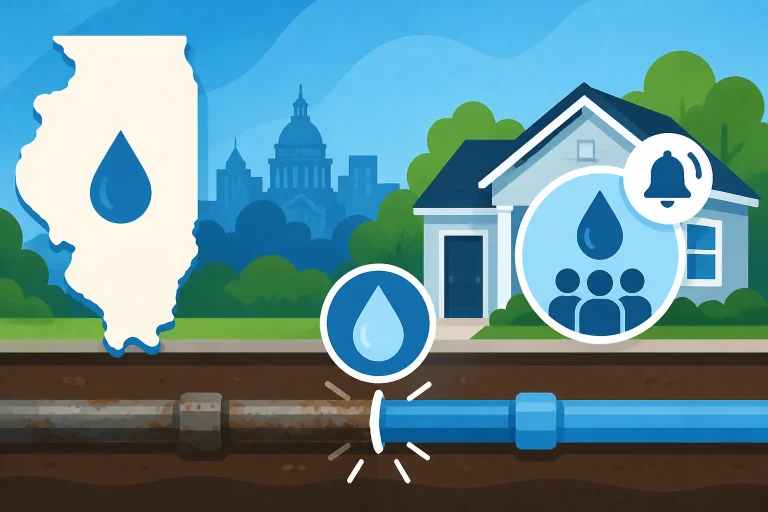
Next, check what the report actually covers. A report describes the water supplied by the system it identifies; it is not automatically a test of water from an individual kitchen faucet. Building plumbing, fixtures and service-line materials can create separate questions that a community-wide report does not resolve. For concerns about lead in a specific home, the appropriate information may include service-line records or a tap sample rather than the source description alone.
When reading the report, look for:
- The system or supplier name. Make sure it matches the provider serving your address.
- The source description. Check whether the report identifies Lake Michigan, another surface-water source, groundwater or water purchased from another supplier.
- The treatment and monitoring information. These sections explain the system’s water-management and testing context.
- Any reported notices or findings. Read them in context, and ask the supplier to explain unfamiliar language or a result that concerns you.
- The report period. Confirm that you are reading the report for the relevant reporting period rather than an older document.
If a report does not clearly name the source, check the supplier’s official website for a source-water description or ask the supplier directly. Avoid treating a general page about a town or region as a substitute for a report tied to the system.
Reports are also not a substitute for a home-specific test when the question is about water that may have changed as it passed through a building’s plumbing. Conversely, a test at one tap does not necessarily establish the source or water-quality status of the wider public system. The right record depends on the question: source, system-wide monitoring or conditions inside a property.
For more on which organization sends the report and how that responsibility may differ from billing, see City Hall or the Water Company: Who Sends Your Annual Report?. And if you have located several reports with similar names, One Company, Many Water Systems: How Illinois Reports Are Split Up can help clarify why the correct system name matters.
What happens between the lake and your faucet
Knowing that a supply comes from Lake Michigan identifies its source, but it does not describe every step that brings water into a home. In general, drinking water moves through a system of intake, treatment, storage and distribution before reaching customer connections. The organizations responsible for those steps can vary. Some suppliers manage more of the process themselves, while others purchase treated water and focus on local delivery.
That difference explains why the name on your bill may not be the name you expect to see in a source description. A local water department can be the customer-facing organization while relying on a separate supplier for the water itself. The supplier’s report may describe the source and treatment, while the local utility handles distribution, service questions or billing.
For a resident, it is usually more useful to map the responsibilities than to assume that one organization does everything. If you have a billing question, contact the organization listed on the bill. If you are asking which source supplies the system, look to the water-quality report or ask the supplier. If a question concerns a pipe or fixture within the property, the building owner or a qualified plumbing professional may need to be involved.
The source is also only one part of the water’s path. Water can change in taste or appearance for reasons that are not obvious from the source alone. Treatment, distribution conditions and plumbing in a building can all be relevant to a particular complaint. A sudden change affecting a single faucet is a different situation from a change affecting several homes or an entire neighborhood. If the water’s taste or odor is the concern, Taste and Odor in Illinois Tap Water: A Homeowner’s Guide offers a separate way to think through the issue.
This is why “lake water” should be treated as a starting point, not a complete description of what a household receives. Use the source information to identify where the system begins, then use the applicable report and supplier contact to understand the rest of the path.
What to do when sources of information disagree
It is common to find incomplete or inconsistent descriptions when looking up a community’s water. A municipal page may describe a source, a bill may name another organization, and a report may be issued under a system name that is unfamiliar. Those details can fit together if different organizations handle purchasing, treatment, distribution and billing.
Before assuming there is a real conflict, compare the records carefully. Check that the address is the same, the system name is consistent, and the documents refer to the same reporting period. Look for words such as “purchases,” “wholesale,” “distribution” or “service area”; they may signal that the documents are describing different roles.
Then contact the supplier using the current contact details on its official website. Ask for a direct confirmation of:
- The provider serving the property.
- The source used by that provider or by its water supplier.
- The report that covers the property’s system.
- Whether the utility’s answer applies to the entire town or only part of it.
- The right contact for a separate question about billing, plumbing or water quality.
If the property is rented, ask the landlord or property manager for the supplier and report. The account may be in the owner’s name, but the service information should still help identify the system. If the home is being purchased, request the current water report and supplier details as part of the property records you review.
For customer concerns that involve an active notice or unusual change, rely on the official supplier’s current instructions rather than a general explanation of lake water. A water source description cannot tell you whether a particular advisory applies to a street or building. For those situations, see Who Issues a Drinking Water Advisory in Illinois, and Who Lifts It?.
The practical goal is not to build a map from rumors or infer a source from a town’s location. It is to connect an address to a named supplier and then connect that supplier to the report describing its system. That approach works whether the water comes directly from a local source or is purchased through another provider.
Frequently Asked Questions
Does living near Lake Michigan mean my home gets lake water?
No. Proximity alone does not confirm a home’s water source. Identify the supplier for the address and check the report that covers its system.
Which Illinois community is confirmed here as using Lake Michigan water?
The City of Naperville identifies Lake Michigan as the source of its drinking-water supply. Its annual Water Quality Report states that the supply complies with all water quality standards as listed in the Safe Drinking Water Act.
Can a town buy Lake Michigan water from another supplier?
A local utility may distribute water purchased from another supplier. Ask the local utility who supplies the water and which report applies to your address; do not assume the biller and source provider are the same organization.
Does a community water-quality report test the water at my faucet?
A community report describes the system it covers. It is not automatically a test of an individual home’s tap or plumbing. If your question concerns conditions inside the building, the appropriate next step may be a home-specific test or plumbing review.
Sources
- City of Naperville — Water Quality | Naperville, IL (checked November 13, 2026)
Disclaimer
This article is for general informational purposes only and does not constitute professional advice. Laws, prices and regulations vary by location and change over time. Consult a qualified professional for guidance on your specific situation. Illinois Water Guide is not a government agency or water utility and is not affiliated with any public water system.