City Tap Water From the Lake: Safety, Testing and When to Filter
Lake Michigan water can travel through a treatment plant, public pipes and your home’s plumbing before it reaches the tap. That raises practical questions: what does the utility test, what can its reports tell you, and when is a home filter useful? The key is to separate the quality of treated city water from issues that can develop in a building’s own pipes and fixtures.
Lake water, treatment and the trip to your tap
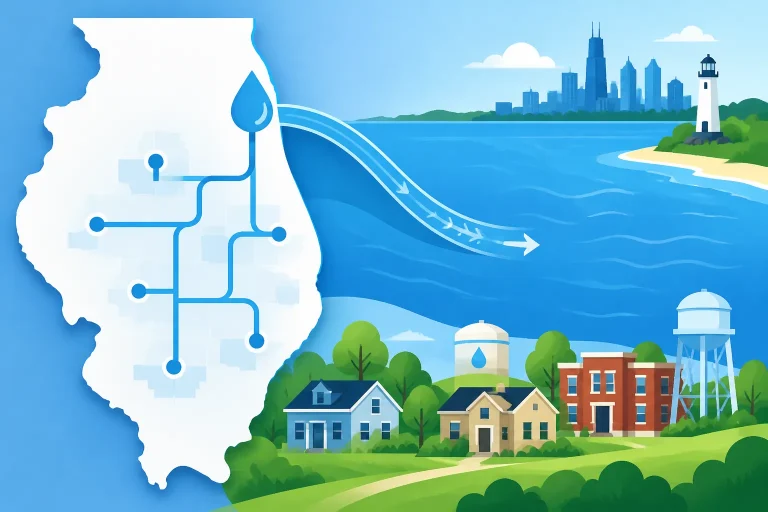
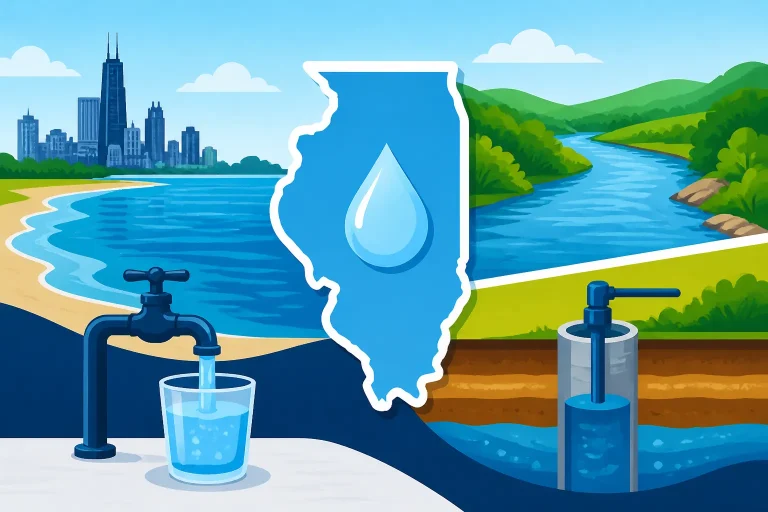
A lake is a source of raw water, not water that is ready to drink as soon as it is drawn. A municipal supplier treats its source water, checks the finished water and distributes it through a network of mains and service lines. From there, the water enters a property’s plumbing and travels to individual taps.
That distinction matters when you assess a concern. A question about the lake or treatment plant is different from a question about a service line, faucet or pipe inside a home. The utility’s testing describes water at particular points in its system; it does not necessarily describe the water that has been sitting in a particular home’s plumbing.
Lake Michigan serves many Illinois communities, but not every community on the lake receives water in the same way. Some towns may obtain water through a larger supplier, while others manage their own treatment and distribution. To identify the source for a particular address, start with the supplier rather than assuming that nearby towns share the same system. Lake Michigan Water in Illinois: Which Communities It Reaches explains how service areas can differ.
Treatment is designed to make source water suitable for distribution and to maintain its quality as it moves through the system. The details depend on the supplier and its treatment process. For Chicago, consult the city’s treatment and water-quality information rather than assuming that another city’s process is identical. A useful overview of treatment stages is available in How Lake Water Is Treated Before It Reaches Your Tap.
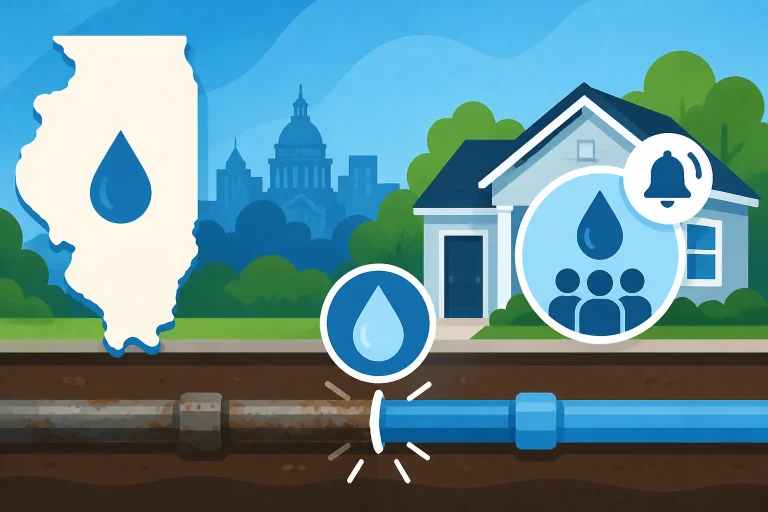
After treatment, the water moves through public mains and service connections. The service line connects the public water main to a building, but ownership and responsibility for its different sections can vary. Inside the building, water then passes through plumbing materials, fixtures and any treatment equipment installed at the property.
This path gives you a practical way to sort questions:
- Concern about the source or treatment: Check the water supplier’s reports and contact the supplier for information about its system.
- Concern about a neighborhood-wide change: Ask whether the supplier has reported a system issue or changed its treatment.
- Concern about one building or tap: Consider the service line and interior plumbing, and look for testing that represents that location.
- Concern about taste or odor: First establish whether the change is limited to one faucet, one property or a wider area. Illinois Tap Water Suddenly Tastes Different: Supply or Your Plumbing? offers a way to think through that distinction.
A city’s report is a starting point, not a guarantee that every tap has identical water. Water can vary with where and when a sample was collected, how long it sat in plumbing, and the materials it contacted. A report can help you understand the system; it cannot, by itself, identify every condition inside a particular home.
How Chicago monitors and reports its water
Chicago provides a useful example of the information a large city supplier makes available, but Chicago’s reports describe the Chicago Water System. A resident of another Illinois community should look for that community’s supplier and reports rather than treating Chicago’s results as local results.
The Chicago Department of Water Management says it is constantly monitoring and testing Chicago’s drinking water quality. It also issues an annual Consumer Confidence Report. The report provides an overview of the Chicago Water System and an annual average water quality data. That overview helps readers understand the system and its reported results, but an annual average is not a test of the water from every individual household faucet.
The department also makes frequently requested reports available. Its Comprehensive Chemical Analysis report is compiled four times annually. That report and the Consumer Confidence Report serve different purposes: one provides an overview and annual average information, while the other is a recurring chemical analysis report. For a more extensive list of test results and reports, the Chicago Department of Water Management directs readers to inquire with the Illinois Environmental Protection Agency (IEPA).
Chicago also provides information about studies of emerging contaminants. The City of Chicago Emerging Contaminant Study summary covers sampling for Endocrine Disrupting Chemicals, Pharmaceuticals, and Personal Care Products. The fact that a study covers a group of substances does not mean that every substance was detected, nor does a study summary necessarily tell you what is present at a particular home’s tap. Read the study’s scope, sampling information and results rather than drawing conclusions from its title alone.
PFAS information calls for similar care. The Chicago Department of Water Management says PFAS studies were conducted separately by the US EPA, Illinois EPA, and City of Chicago. Separate studies may differ in purpose, sampling locations, dates and the substances included. Do not combine results from different studies as though they were one continuous test program. For a wider explanation of results, standards and household options, see PFAS in Illinois Drinking Water: Standards, Sampling and Your Options.
A helpful report-reading routine is to check:
- Who issued the report. Confirm that it is for the supplier serving your address.
- What part of the system was sampled. A system-wide sample may not represent a particular building’s plumbing.
- When sampling took place. Results describe the sample collected at that time, not every moment or every location.
- Which substances or measurements were included. A result cannot answer a question about a substance that was not tested.
- How the result is described. Pay attention to the report’s units, monitoring period and any explanation supplied by the utility.
- Where to request additional information. If a report points readers to another agency or office for a fuller record, use that route to ask about the underlying data.
For more help interpreting the format and limitations of these reports, see Consumer Confidence Reports in Illinois: Reading Your Water Report. You can also use Illinois Drinking Water Watch: Looking Up Test Data and Violations to understand how public-system records differ from a home plumbing test.
What a water report can and cannot tell you
A utility report is useful for understanding the public water system. It can show what the supplier reports about its monitoring and water quality, and it can direct you to additional records. It is not a substitute for every type of investigation a household might need.
What it can help with
A report can help you learn which supplier serves the system, understand the information the supplier publishes and identify whether a particular contaminant or measurement is included. If you are comparing reports from different years, the report can also help you see how the supplier presents results over time. For advice on making that comparison, see Comparing Past Years of Your Illinois Water Quality Reports.
A report may also help clarify whether a concern is being discussed at the system level. If a supplier reports a system-wide issue or provides instructions for customers, follow the supplier’s current notice. If there is no notice, do not assume that an unrelated result from another community applies to your address.
What it cannot establish on its own
A system report does not tell you exactly what is coming from a specific faucet at a specific moment. It may not capture the effect of a building’s service line, plumbing, fixtures or water sitting in pipes. It also cannot prove that a concern is absent if the substance in question was not included in the report or the sample did not represent your location.
This is particularly important for lead. The quality of treated water and the materials in a home’s plumbing are separate parts of the picture. A utility report can describe system monitoring, but it does not establish whether a particular home has a lead service line or whether lead is present at a particular tap. For that, you may need information about the service line and a suitable test. Does an Illinois Water Quality Report Show Lead in Your Own Home? explains why the two kinds of information are not interchangeable.
A report should also be read within its stated scope. A study of a set of emerging contaminants is not automatically a full inventory of every possible contaminant. A summary of a study does not necessarily present every sample result. If you need a specific result, check whether the report includes it and ask the supplier or relevant agency how to access more detailed records.
How to respond to a result that concerns you
Read the full report entry rather than focusing on a single number or phrase. Confirm the sampling period, the location or system covered, and the units used. Then compare the result with the report’s own explanation and any guidance the supplier provides. If a result is unclear, ask the supplier what it represents and whether additional records are available.
If the question is about the water at your own tap, describe that clearly when asking for help. Say whether the concern affects one faucet or multiple taps, whether it began after plumbing work, and whether you are seeking a system record or a test of household water. Those details help distinguish a public-system question from a building-plumbing question.
For a health-related concern, contact your local health department or a medical professional. A water report is not individual medical advice, and a home filter should not be treated as a substitute for professional guidance.
Lead and the plumbing between the main and the faucet
Lead is a special case because it can come from plumbing materials rather than the lake itself. Treatment-plant or system-wide results cannot tell you, by themselves, what is happening in a particular building’s service line, pipes or fixtures. A home’s age and service-line material can make a closer look worthwhile.
The City of Chicago says houses or two-flats built before 1986 are highly likely to have a lead service line unless it was replaced during a renovation or an addition. That is a reason to check records or ask about the line, not proof that every older home has one. A property’s renovation history may not tell the whole story, so verify the actual service-line material where possible. Lead Service Lines in Illinois: The Replacement and Notification Act gives broader context on service lines and replacement requirements.
Chicago residents can request a free lead water test by calling 311. The City of Chicago also identifies its water-quality website as a way to request the test. If you live outside Chicago, contact the supplier serving your address to ask whether it offers household lead testing or can explain how to arrange a test.
A test needs to be collected according to the instructions that apply to that testing program. Sampling methods matter: a result from one collection approach should not be treated as though it came from a different one. If a utility provides a kit or collection guidance, follow it closely, and ask the supplier if you are uncertain which faucet or sampling procedure is appropriate. How Long Illinois Tap Water Should Sit Before a First-Draw Lead Sample explains why collection instructions matter.
If a lead result concerns you, ask what the result represents and what steps the supplier or local health department recommends. Do not assume that boiling will remove lead; boiling does not remove lead from water. If you want a filter, match the product’s certification and specific reduction claim to the issue you are addressing, and follow the manufacturer’s instructions for installation and cartridge replacement. A filter that is not certified for the contaminant of concern is not a reliable substitute for checking the claim.
Chicago recommends using an NSF-53-certified filter to remove lead for the first three months after lead service line construction. The City of Chicago also recommends free follow-up lead testing after a service line replacement. These instructions apply to the described Chicago work; for work in another community, follow the local supplier’s instructions and ask what testing or interim steps it recommends.
A filter is not the same as replacing a lead line, and it does not establish that a service line has been addressed. If line material is unknown, ask the supplier how to verify it and what records are available. If you are a renter, you can ask the landlord and utility about the line and any available testing. Renters and Lead Service Lines: Questions for an Illinois Landlord covers practical questions for tenants.
When a home filter may help, and when it may not
A filter can be useful when it is chosen for a specific purpose. It can also be unnecessary, poorly matched or difficult to maintain if the reason for buying it is vague. The most practical question is not “Is lake water filtered enough?” but “What problem am I trying to address, and what evidence do I have about it?”
Start with the reason, not the product
Common reasons for considering a filter include wanting to change taste or odor, addressing a test result, or following a utility’s advice after work on a service line. These are not interchangeable goals. A product designed to improve taste may not be certified to reduce lead or a specific chemical. A product selected for one contaminant may not address another.
If the concern is taste or odor, first check whether the supplier has information about the change and whether it affects other homes. A change isolated to one tap could point to a fixture or plumbing issue, while a broader change may warrant a question to the supplier. A filter may improve some aesthetic qualities, but it does not explain why a change happened or establish that the water is unsafe. Taste and Odor in Illinois Tap Water: A Homeowner’s Guide can help you think through the difference.
If the concern is a reported contaminant, use the test result and the product’s certification as a pair. Check that the filter’s certification covers the specific contaminant and that the product is designed for the way you intend to use it. Do not infer a reduction claim from a general phrase such as “water purifier” or from a list of substances that does not identify a relevant certification.
Match the treatment location to the question
A point-of-use filter treats water at a particular tap or appliance. A whole-house system treats water at the entry point to the home. The right setup depends on what you are trying to address and where the water is used. If your concern is drinking and cooking water at the kitchen tap, a treatment system serving that location may be more relevant than treating every tap. If your concern applies to water throughout the building, ask a qualified professional whether a whole-house approach is appropriate.
For a suspected lead issue, think carefully about placement and the specific certified claim. A system that treats water at only one tap does not treat water from other taps. A whole-house system does not automatically resolve lead concerns at a particular faucet unless it is certified and installed for that purpose. Whole-House vs. Point-of-Use Water Treatment in Illinois Homes explains the difference in more detail.
Include upkeep in the decision
Filters need to be used and maintained as directed. Check how the manufacturer specifies installation, flow, cartridge changes and any maintenance needed. A neglected cartridge or a system used outside its instructions may not perform as intended. Keep a record of service and replacement so you can tell whether the equipment is being maintained on schedule.
Also consider the practical trade-offs: how often the unit needs attention, whether it fits the plumbing and kitchen layout, and whether you will consistently use the treated tap. A system that is inconvenient to maintain may not be a good fit even if its claim matches your concern. A Maintenance Calendar for Illinois Filters and Softeners covers the upkeep side of treatment.
If you are comparing products, a brand such as Clearly Filtered is only relevant if the particular model’s certification and reduction claims match your test results and intended use. Check the model-specific documentation rather than relying on the brand name. No filter should be treated as a universal solution, and no product claim replaces a suitable test or the supplier’s instructions.
| Your concern | What to check first | When a filter may be relevant |
|---|---|---|
| Taste or odor | Whether the change is local to one tap or reported across the system | If a suitable product is designed and certified for the specific aesthetic issue |
| Possible lead from plumbing | Service-line material, household testing and supplier guidance | If a filter is certified for lead reduction and used as directed |
| A result for a specific contaminant | What the sample covered and whether the result represents your address | If the product’s certification covers that contaminant |
| General worry about lake water | The supplier’s report and the system that serves your address | Not by itself; identify a specific concern before selecting treatment |
| Recent service-line work | The utility’s post-construction instructions | When the supplier recommends a filter for the specified period |
For a step-by-step approach to selecting a system based on a real concern, see Filter or No Filter? Deciding for an Illinois Home on City Water and Matching a Home Water Filter to the Problem in Illinois.
A practical way to check the water serving your address
The process is more manageable when you establish who supplies the water, identify the question you need answered and choose the right record or test.
- Confirm the supplier. Look at a recent water bill or ask the property owner or manager. A community’s name alone may not identify the supplier for every address.
- Find the supplier’s report. Use the report for the system serving your home, not a nearby town’s report or a report for a regional wholesaler alone. How to Find Out Who Supplies Water to Your Illinois Address can help when the supplier is unclear.
- Read the scope and timing. Check what was sampled, what substances are listed and the period the results cover. For Chicago, the Consumer Confidence Report provides an overview and annual average water quality information; Chicago’s Comprehensive Chemical Analysis report is compiled four times annually.
- Separate system questions from home questions. For the system, contact the supplier or review its records. For a service line or indoor plumbing concern, ask about the property and consider testing that represents the home.
- Ask for the exact record you need. Chicago’s Department of Water Management directs people seeking a more extensive list of test results and reports to inquire with the Illinois Environmental Protection Agency. A customer of another supplier should ask that supplier where its detailed records are available.
- Use the right test. A test should be selected for the substance and sampling point relevant to the question. If a home test kit or utility program has specific instructions, follow them carefully.
- Decide about treatment only after that. Compare a filter’s certification and stated reduction claim with the test result, and consider upkeep before buying.
If an issue affects several neighboring properties or appears alongside a utility notice, contact the supplier using its official contact information. If the issue is isolated to one home, keep notes about which taps are affected and whether the change followed plumbing work, construction or a period when the water was unused. That information can help the utility or a qualified plumbing professional narrow down the source.
A household can also combine sources of information without treating them as interchangeable. A utility report explains system-level monitoring. A service-line record describes the line material, if known. A properly collected home sample reflects the water at the sampling point under the collection conditions. Each fills a different gap; none should be stretched beyond what it measures.
Frequently Asked Questions
Is Lake Michigan water automatically safe because it is treated?
No single source label answers every question about water at a home’s tap. A municipal supplier treats and monitors its water, but a home’s service line and plumbing can affect what reaches a faucet. Check the report for the supplier serving your address and investigate household plumbing concerns separately.
Does Chicago’s water report describe every Illinois community on Lake Michigan water?
No. Chicago’s reports describe the Chicago Water System. Communities can have different suppliers, treatment systems and reports, even when they receive water connected to the same lake source. Check with the supplier for your address.
Does an annual water report show whether my faucet has lead?
Not necessarily. A system report does not establish the condition of every service line, interior pipe or fixture. Check the line material and ask about a suitable home test. Chicago residents can request a free lead water test by calling 311.
Do I need a filter if my supplier monitors its water?
Not automatically. Monitoring information and a home filter solve different problems. First identify the reason you are considering treatment, then check the relevant test information and the filter’s certification. A filter is useful only when it matches the specific concern and is maintained as directed.
Where can I get more detailed Chicago test results?
The Chicago Department of Water Management directs readers seeking a more extensive list of test results and reports to inquire with the Illinois Environmental Protection Agency. For a particular question, identify the report or contaminant you are looking for when you make the inquiry.
Sources
- Chicago Department of Water Management (checked October 2, 2026)
- City of Chicago — Water | Lead-Safe Chicago (checked November 13, 2026)
Disclaimer
This article is for general informational purposes only and does not constitute professional advice. Laws, prices and regulations vary by location and change over time. Consult a qualified professional for guidance on your specific situation. Illinois Water Guide is not a government agency or water utility and is not affiliated with any public water system.