Consumer Confidence Reports in Illinois: Reading Your Water Report
A Consumer Confidence Report can look like a dense spreadsheet, especially when it lists unfamiliar contaminant names, measurements and regulatory terms. The key is to read it as a report about a water system—not a test of every faucet or home in Illinois. Here’s how to find the right report, interpret its main sections and decide what to check next.
What an Illinois Consumer Confidence Report tells you
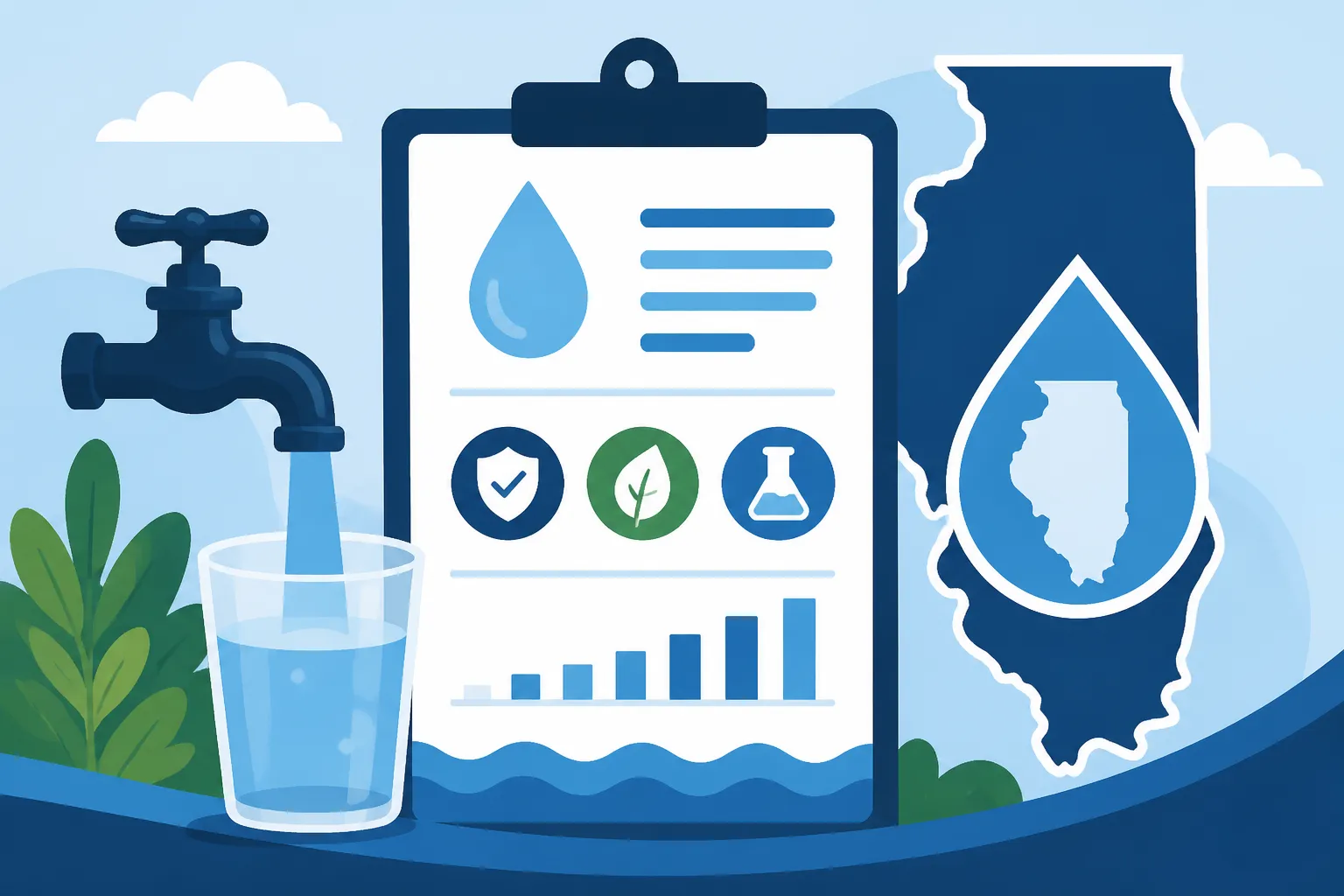
A Consumer Confidence Report, often called a water quality report, summarizes information about the water supplied by a community water system. The City of Rockford describes it as an annual water quality report that the Safe Drinking Water Act requires. The City of Aurora says drinking water utilities publish information about their water annually, including the source and quality of your drinking water.
That makes the report useful for understanding the system’s water supply and its reported results. It is not a complete record of every condition that could affect water at a particular address or tap. Water can travel through distribution pipes and building plumbing before it reaches a glass, and the report does not test every household’s plumbing.
The report’s main purpose is to communicate system-level water quality information, including regulated contaminants found in drinking water and health effects information related to violations of drinking water standards. A contaminant appearing in a report does not automatically mean the system violated a standard. The details matter: check the reported result, the applicable standard or comparison value, the time period and whether the report identifies a violation.
Illinois reporting obligations can cover public supplies as well as community systems. The Illinois Environmental Protection Agency says public water supply well owners and operators must notify end users of violations of federal drinking water standards and provide annual Consumer Confidence Reports. For a community water system, the City of Rockford also describes an annual report requirement under the Safe Drinking Water Act.
A report is most useful when you treat it as a starting point for questions rather than a universal stamp of approval or a diagnosis of your household plumbing. It can help you understand what the supplier monitors and reports, see whether violations are described, and identify what further information may be worth seeking.
If you are unsure which system serves your address, start with How to Find Out Who Supplies Water to Your Illinois Address. That matters because nearby homes can have different suppliers, and a report for a neighboring town may not describe the water delivered to your home.
Find the report for your actual water system
Before interpreting a report, make sure it belongs to the supplier serving your address. A city name on a bill or a familiar utility logo may not tell the whole story. Some communities purchase water from another supplier, and some addresses within or near a municipality may be served by a different system. A report for the water source, wholesaler or neighboring community may provide useful context, but it is not necessarily the report customers at your address should use.
Check your water bill, service notices or account information for the supplier’s name. If the bill does not make the supplier clear, ask the billing office or water provider which system serves the service address. For more context about wholesale arrangements, see Does Your Illinois Suburb Buy Its Water From a Bigger City?.
Once you have the supplier name, look for its Consumer Confidence Report on the supplier’s official website or request directions to the report from the supplier. The report may be listed under names such as water quality report or drinking water report. If the supplier posts several reports, check that the report identifies the correct system and reporting period. A utility serving multiple communities may publish separate reports rather than a single document for every customer.
Illinois EPA’s Drinking Water Watch portal provides online information about the quality of water produced by public water supply wells in Illinois, including supplies both from surface water and groundwater. The portal can help you look up public-supply information, but an online record and a customer-facing report serve different purposes. Use the report for the system’s summary and the portal when you want to investigate available system information. Illinois Drinking Water Watch: Looking Up Test Data and Violations explains how to approach that search.
The report’s title page, opening section or system description should help establish whose water it covers. Look for the supplier or system name, the communities or service area named, and any description of the source. If the coverage is unclear, do not assume the report applies just because the utility name sounds familiar. Ask the supplier to confirm which report covers your service address.
A landlord, property manager or homeowners’ association may also handle water billing or distribute notices. If you do not receive a report directly, that does not necessarily mean there is no report. Ask the responsible party which water system serves the property and where its report can be found. For more on how reports are posted, see Where a City-Owned Utility Posts Its Water Quality Reports.
Check the reporting period
A report summarizes information for a defined reporting period, so look for the period named in the document before comparing it with another report or a recent notice. The most recently posted report is not necessarily a real-time status screen. It reflects the information compiled for its stated period, while newer sampling results, system changes or advisories may be communicated separately.
If you are trying to understand a recent change in taste, odor or appearance, the report may not explain what you noticed at home. Check for current notices from the supplier and consider whether the issue could be associated with household plumbing. Illinois Tap Water Suddenly Tastes Different: Supply or Your Plumbing? can help frame that distinction.
Read the source and treatment information first
The section about the water source gives useful context for understanding the rest of the report. The City of Aurora says reports contain information about the source and quality of drinking water. The source may be surface water, groundwater or a supply arrangement that involves water purchased from another system. Treat this section as a description of where the system’s water comes from, not as a guarantee that every contaminant is absent.
Source information can help explain why two neighboring communities report different results. Water from different sources can have different characteristics, and suppliers may use different treatment processes. Even when a utility buys treated water from a larger supplier, the customer-facing report should be read for the system identified in the document. Where Illinois Tap Water Comes From: Lake, Rivers and Wells gives more background on common source types.
Look for the system’s description of treatment, too. The report may describe processes used to prepare water for distribution or explain how the supplier manages water quality. Read this as a summary of system operations, not an instruction to install the same equipment at home. Household treatment decisions depend on the specific concern and, where appropriate, test results from the relevant tap.
Some reports explain how customers can obtain more information, ask questions or access additional records. These details can be useful if a result is unclear or if you want to know what the utility’s table covers. The supplier is the right place to ask about its own source, monitoring, treatment and report terminology. Use the utility’s official website to find current contact details.
Separate source information from household plumbing
A source-water description concerns the system’s supply. Water may then move through treatment facilities, mains, service lines and plumbing inside a building. The Consumer Confidence Report is not a personal test of the pipes, faucets or fixtures in an individual home. That distinction is especially important when the concern involves lead, because a system-level report cannot tell you what is happening at every tap.
A report can still be relevant to a household concern: it provides context about the supplier and the system’s reported results. But if your question is whether water from a particular faucet contains lead, seek information specific to that issue rather than treating the report as a home test. Does an Illinois Water Quality Report Show Lead in Your Own Home? covers that limitation, and Lead in Illinois Drinking Water: Sources, Home Tests and Results discusses why plumbing and sampling point matter.
The same basic distinction applies to taste, odor, staining or a result from a home test. A system report can describe the public supply, but it does not necessarily explain a change that appears only in one building or at one fixture. For unusual water appearance or a result that concerns you, contact the supplier and, when appropriate, seek advice from the relevant local health department or a qualified water professional.
Work through the contaminant table carefully
The contaminant table is often the section readers turn to first. The City of Rockford says a Consumer Confidence Report lists regulated contaminants found in the drinking water, as well as health effects information related to violations of drinking water standards. The table can be difficult to scan because it may use technical names, abbreviations and units. Rather than focusing only on whether a contaminant is listed, read each row across and use the report’s definitions.
Start by identifying the contaminant name and the type of result being reported. A name may refer to a chemical, a group of related compounds or a category of organisms. The result may also be described with a measurement unit or a term defined elsewhere in the report. Avoid comparing figures until you know they refer to the same contaminant, unit and type of measurement.
Next, find the value or benchmark the report uses for comparison. Reports can include regulatory standards, goals or other reference values, and those terms do not necessarily mean the same thing. If the table uses abbreviations or technical language, look for a key or definitions section before drawing a conclusion. The report’s own definitions and the supplier’s explanation are better guides than guessing from an abbreviation.
Then check how the reported result compares with the stated benchmark. A result below a standard is different from a result that exceeds it, and a detected contaminant is not automatically a violation. A violation is a separate status that the report should identify or explain. If the table does not make the comparison clear, ask the supplier to explain the row and the period it covers.
Finally, read any note linked to that result. Notes may explain how the result was calculated, what sample set it represents, whether the value is an average or a range, or what follow-up occurred. The wording varies by report, so do not assume that a figure means the same thing in every table. A value’s meaning depends on its label, unit, sampling context and the report’s definitions.
| What to find | What to check | Why it matters |
|---|---|---|
| Contaminant name | Confirm the exact substance or category listed | Similar names may refer to different contaminants or groups |
| Reported result | Read the value together with its unit and label | A number without its unit or result type can be misleading |
| Comparison value | Find the standard, goal or other benchmark named in the report | Different benchmarks can serve different purposes |
| Violation status | Look for an explicit statement or explanation of a violation | A detection alone does not establish a violation |
| Notes and definitions | Read the footnotes and terms used for the table | Notes can explain how to interpret the result |
| Reporting period | Confirm which period the result describes | The report is not necessarily a real-time measurement |
Understand detection, standards and violations as separate ideas
A contaminant can be detected without the report identifying a violation. Detection means the substance was found in the samples described by the report. Whether that result violates a drinking water standard depends on the applicable requirement and how the result compares with it. The report should be read for that comparison rather than using the word detected as a substitute for a regulatory conclusion.
A standard or limit is also not the same thing as a health goal or advisory. If the report lists more than one reference value, check the labels and definitions rather than assuming they are interchangeable. Ask the supplier which value applies to compliance and what the other values are intended to explain. A qualified professional or local health department can help with questions about health implications.
Results can be reported in ways that are not immediately intuitive. The report may show a range, an average, a highest result or a value calculated from multiple samples. It may also include a footnote explaining why the number is presented in a particular form. Do not infer the worst or best case from a table until you know what the reported statistic represents.
If you see a contaminant name you do not recognize, write down the exact name, result, unit and footnote before asking for clarification. That makes it easier for the supplier to identify the correct line. If the result concerns a health question, ask the local health department or a medical professional rather than relying on a general description in a report.
Understand what a violation means and how to read its explanation
A violation is not simply another way to say that a contaminant was detected. It means the report identifies a failure to meet a drinking water requirement or another reporting or monitoring obligation. Read the report’s explanation to determine what type of violation it describes. The issue may involve a water quality result, a monitoring requirement, reporting or another compliance matter.
The distinction matters because a monitoring or reporting violation is not the same as a result showing that a contaminant exceeded a standard. If the report uses the word violation, look for the accompanying description rather than assuming the reason. The report may explain what happened, when the system returned to compliance or what steps were taken. If those details are missing or hard to interpret, ask the supplier to clarify the violation category and the status it reports.
The Illinois Environmental Protection Agency says public water supply well owners and operators must notify end users of violations of federal drinking water standards and provide annual Consumer Confidence Reports. The report can therefore be one way to learn about a violation, but it is not the only communication channel. A supplier may also issue a separate notice when customers need more immediate or specific information.
Read any health effects information alongside the violation explanation. The City of Rockford describes the report as listing regulated contaminants found in the drinking water, as well as health effects information related to violations of drinking water standards. That information is intended to explain the concern associated with a violation. It is not a substitute for personal medical advice, and a general health statement should not be treated as a prediction about an individual’s health.
If a notice gives specific directions about how to use water, follow the current instructions from the supplier or relevant authority rather than relying on an older report. A yearly summary and a current advisory are different kinds of communication. Who Issues a Drinking Water Advisory in Illinois, and Who Lifts It? explains the role of advisories and why it is important to check the latest notice.
For a violation that is not clearly described, ask the supplier what requirement was involved, what period it covers, whether customers need to take any action and where the current status is posted. Keep the report and any related notice together. That helps avoid mistaking a historical explanation for a current instruction—or assuming that a past violation has no follow-up information.
Know what the report can and cannot tell you about your home
A Consumer Confidence Report describes water quality information for a public system. It does not provide a result for every home, faucet or point in the distribution network. A customer’s water may pass through a service line and building plumbing before reaching the tap, and the condition or materials of those pipes can differ from one property to another.
For that reason, a system-level report cannot confirm whether a specific household has lead in its plumbing or what a sample from a particular faucet would show. It also cannot establish that every fixture has the same water quality. If lead is the concern, use information about the home’s service line and plumbing, and follow the utility’s or testing program’s instructions for any sample. Lead, Galvanized or Unknown? Verifying Your Illinois Service Line can help with the pipe-material question.
The report may include monitoring results collected under the system’s requirements, but those results represent the samples and methods described by the report. They should not be treated as a test of a different location or a different time. A result from the public system does not replace testing of a private well, and a report for a municipal supplier does not describe water from a separate supply.
Likewise, a report may not answer every question about a taste or odor noticed at home. Some changes may relate to the supply or treatment; others may be associated with plumbing, a fixture or conditions in the building. Use the report as background, then contact the supplier about system-wide changes and seek appropriate testing or professional advice when the concern is specific to the home. For a taste or odor issue affecting multiple residents, see When a Whole Neighborhood Notices a Water Taste Change in Illinois.
A report is also not a substitute for a current notice. If the supplier has issued a recent advisory or instructions, check those directly. A report describes information for its named period; current utility communications are the better source for a newly reported event or directions that customers need to follow.
When the question is about possible health effects, do not try to make a medical judgment from a table alone. Ask the local health department or a medical professional. When the question is about the utility’s monitoring, system results or compliance status, ask the supplier or consult the relevant Illinois EPA information.
Turn the report into a practical next step
A report can help answer broad questions, but it is most useful when you connect each question to the right follow-up. Start by identifying what prompted you to read it. You may be checking the general quality of the supply, looking for a particular contaminant, investigating a violation, or trying to understand a concern at home. Those are different questions and may require different information.
Use a simple review process:
- Confirm the supplier and the system named in the report match your service address.
- Check the reporting period and the source information.
- Find the relevant contaminant or compliance entry, if any.
- Read the result, unit, comparison value, violation status and footnotes together.
- Note what the report does not answer, such as a question about a specific home tap.
- Ask the supplier for clarification about system results, current notices or report terminology.
- Seek home-specific testing or professional guidance when the concern is about plumbing, a private well or an individual health question.
If you are comparing reports, keep the supplier, reporting period, units and table definitions in view. A change from one report to another may reflect a real change in the system, but it may also reflect a different sampling approach, a different way of reporting or a revised source arrangement. Do not interpret a change in a table without checking the report’s notes and asking the supplier when necessary. Comparing Past Years of Your Illinois Water Quality Reports offers a more focused way to make those comparisons.
If your concern is a specific contaminant, look for the exact name rather than relying on a broad category. A report may list only regulated contaminants and may not answer every question about substances someone has heard about. For additional records or more detailed test information, use the supplier’s report and Illinois EPA’s Drinking Water Watch portal as starting points, then ask which information applies to the system serving your address. The portal provides online information about water produced by public water supply wells; it should not be confused with a household test result.
If your concern is lead, the next useful question may be the material of your service line or the plumbing inside the home, not simply whether lead appears in the report. If your concern is a private well, a community system’s report does not describe that well. If your concern is a current taste, odor or appearance change, check current supplier notices and ask whether the issue is system-wide. Matching the question to the right source of information can save time and prevent a system report from being asked to answer something it cannot.
When you contact the supplier, be specific. Identify the report and reporting period, the exact table row or wording, and what you want to know. For example, ask whether the result is a detection or a violation, what the unit means, whether the figure is an average or another statistic, or whether a newer notice has been issued. If the answer involves health effects, follow up with a local health department or medical professional.
Frequently Asked Questions
Does a Consumer Confidence Report mean my tap has been tested?
No. The report summarizes information about the water system and its reported monitoring. It is not a test of every home or faucet. For a home-specific concern, identify the right type of test and sampling point.
If a contaminant is listed, does that mean the water violated a standard?
Not necessarily. A listing may show that a contaminant was found. Read the result, unit, comparison value, violation status and notes together. Ask the supplier if the report does not make the distinction clear.
Where can I look up Illinois public water supply information online?
Illinois EPA’s Drinking Water Watch portal provides online information about the quality of water produced by public water supply wells in Illinois. Confirm that the system you find is the one serving your address.
What should I do if the report describes a violation?
Read the violation explanation and any associated health effects information, then check for current supplier notices or instructions. Contact the supplier with questions about the system’s status. For health questions, ask the local health department or a medical professional.
Sources
- Illinois Environmental Protection Agency — Drinking Water (checked November 13, 2026)
- City of Rockford, Illinois — Consumer Confidence Report | Rockford, IL (checked November 13, 2026)
- City of Aurora, Illinois — Water Quality Reports | City of Aurora, IL (checked November 13, 2026)
Disclaimer
This article is for general informational purposes only and does not constitute professional advice. Laws, prices and regulations vary by location and change over time. Consult a qualified professional for guidance on your specific situation. Illinois Water Guide is not a government agency or water utility and is not affiliated with any public water system.